
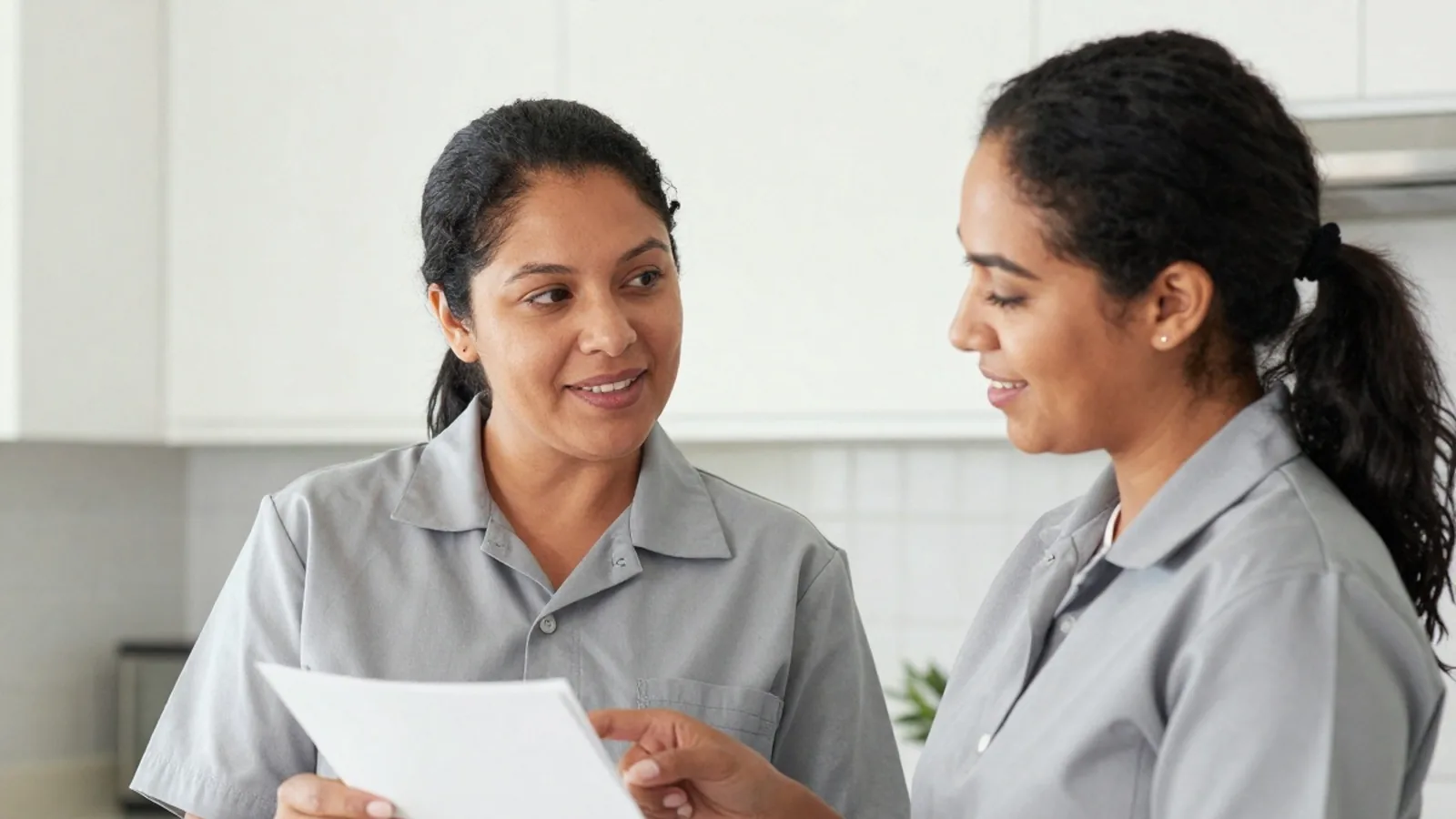
Almost 1 in 5 People in the U.S. Speak Another Language at Home. Does Your Cleaning Business?
If your team or your clients speak Spanish, Portuguese or another language at home, your cleaning business should work in that language too. It is common: in 2019, 67.8 million people in the United States spoke a language other than English at home, almost 1 in 5. Spanish was 62% of them.
The number behind the question
According to the U.S. Census Bureau story "What Languages Do We Speak in the United States?", published in December 2022 with data for 2019, 67.8 million people spoke a language other than English at home. That is almost 1 in 5 people. Spanish accounted for 62% of them.
The data is from 2019, so treat it as a picture of the country, not of your city. Your own client list and your own team are the real numbers that matter. Still, the national picture explains something many owners feel every day: a cleaning business runs on clear instructions, and every handoff is a place where meaning can get lost. It gets lost faster when people are working in their second language.
Where language breaks a cleaning job
Think about the path an instruction travels. The client explains what matters in their home. You turn that into a checklist and a price. Your team follows the checklist inside the home, often without you there. Then the client reads an invoice and decides whether the visit matched what they asked for.
Each step can go wrong in a different language. A client who never fully understood what "standard clean" includes argues about extras. A cleaner who reads the checklist in a language she reads slowly skips a line. A note about the dog, the alarm or the room that stays closed gets lost in a text thread. None of these is a cleaning problem. All of them become a cleaning complaint.
Speaking your team's language
Your cleaners are the ones in the home. If the standard only lives in English, or only in your head, it will not be followed the same way twice.
- Write the checklist in the language your team reads best. Same room order, same tasks, same "do not touch" list, in every language you use.
- Use short sentences and photos. "Wipe inside the microwave" beats a paragraph. A photo of how the bed should look beats both.
- Put house notes where everyone can see them. Alarm code, pets, the room that stays closed, the products the client does not want used.
- Keep the schedule in one place. Who goes where, when, and with what instructions, in a language every team member understands.
- Confirm, don't assume. Ask a new team member to explain the checklist back to you in their own words.
Chemical safety is a language issue too
Cleaning products are chemicals, and safety information only works if people understand it. OSHA's Hazard Communication standard requires employers with hazardous chemicals in the workplace to have labels and safety data sheets for exposed workers and to train them to handle the chemicals appropriately. OSHA describes the updated standard as moving workers from the "right to know" to the "right to understand".
In practice, that means your training on products, dilution and mixing should happen in a language each employee understands. Keep it simple: which products go in which rooms, which ones never get mixed, what the pictograms on the label mean, and where the safety data sheets are. If your crew includes independent contractors, the obligations can be different, but the safety habit is the same.
Speaking your clients' language
Some of your clients would rather read a quote in Spanish or Portuguese. Some want English. Most never say it unless you ask.
- Ask once, at sign-up: "Which language do you prefer for messages and invoices?" Save the answer in the client's file.
- Send quotes and invoices in that language. A client who understands exactly what is included argues less about what is extra.
- Use the same terms every time. If "deep clean" includes the inside of the oven, say it the same way in every language and every document.
- Send reminders in their language. They get read. Get written consent before you text; see our guide on texting clients with consent.
Small habits that help
- Keep a short glossary of your service terms in each language you use: standard clean, deep clean, move-out, add-ons, cancellation fee.
- Have one bilingual person review your client-facing templates once: quote, agreement, invoice, reminders.
- Don't rely on machine translation for anything that affects price, scope or safety without a human check.
- Match the language of the agreement to the language of the conversation. If you sold the service in Spanish, offer the service agreement in Spanish too, and have an attorney check both versions.
- Write down who speaks what on your team, so you can pair a new cleaner with someone who can explain the job in her language.
Bilingual as a hiring and growth advantage
A business that can explain its service clearly in two or three languages can serve clients that bigger competitors handle poorly. The same is true on the hiring side: people want to work where they understand the rules and can ask questions without fear of looking slow. You don't need to be fluent in every language to get this right. You need written standards, one place for instructions and the habit of confirming that people understood.
Where WeCazza fits
WeCazza is software for cleaning businesses, with the interface in English, Spanish and Portuguese. The team's schedule and each home's instructions stay in one place, and clients can pay invoices by card or ACH through Stripe. Each person can use the app in the language they read best.
Frequently asked questions
How many people in the U.S. speak a language other than English at home?
According to the U.S. Census Bureau, 67.8 million people did in 2019, almost 1 in 5. Spanish accounted for 62% of them.
Do I have to train cleaners in their own language?
OSHA's Hazard Communication standard requires employers to train exposed workers on hazardous chemicals and says information must be understandable to workers. Training in a language each employee understands is the practical way to do that.
Should I send invoices in Spanish or Portuguese?
Send them in the language the client prefers. Ask once at sign-up, save the answer and use the same service terms in every language.
Is machine translation good enough for client documents?
It helps with drafts, but anything that affects price, scope or safety should be checked by a person who reads both languages.
Official sources
Checked on November 23, 2026.
- U.S. Census Bureau, What Languages Do We Speak in the United States? (December 2022, data for 2019): 67.8 million people, almost 1 in 5, Spanish 62%.
- Occupational Safety and Health Administration, Hazard Communication: labels, safety data sheets and training on hazardous chemicals.